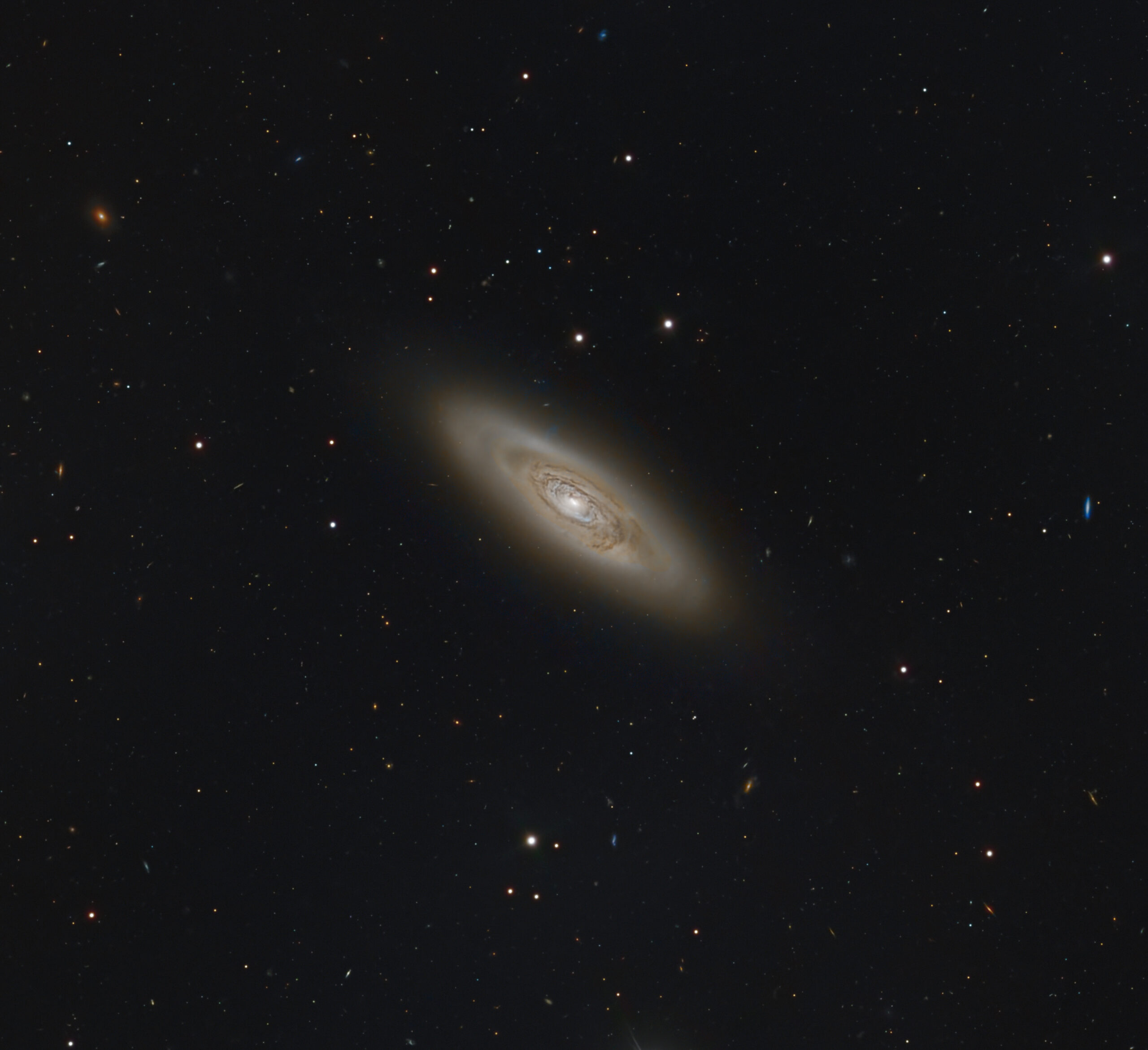
A tilted island of dust and light in the depths of Fornax
NGC 1386 is a striking lenticular galaxy in the Fornax Cluster, catalogued as SA0/a: and viewed almost perfectly from the side. At a distance of roughly 46 million light-years, it spans about 3.1 × 0.9 arcminutes on the sky, corresponding to a physical extent of around 42,000 light-years. The luminous central bulge transitions smoothly into a diffuse, faint outer halo, while a sharply defined dust lane slices across the core, revealing the layered internal structure of its inner disk. Subtle traces of embedded spiral features can be seen around the nucleus, hinting at a more complex dynamical history than a pure lenticular form would suggest.
NGC 1386 also hosts a Seyfert 2 nucleus, a type of active galactic nucleus in which narrow-line emission regions surround a central engine hidden behind obscuring dust. Although this activity is not dramatic in broad-band color, the presence of the dust lane and the tightly wound inner structure reflect the interplay between the bulge, disk, and nuclear region. The extended halo around the galaxy fades gradually into the surrounding star field, and the background is scattered with distant, higher-redshift galaxies that provide a sense of depth behind the more prominent Fornax foreground population.
Imaged in LRGB on my Planewave CDK 1000 at Observatorio El Sauce, Chile.
Image acquisition and processing: Mike Selby