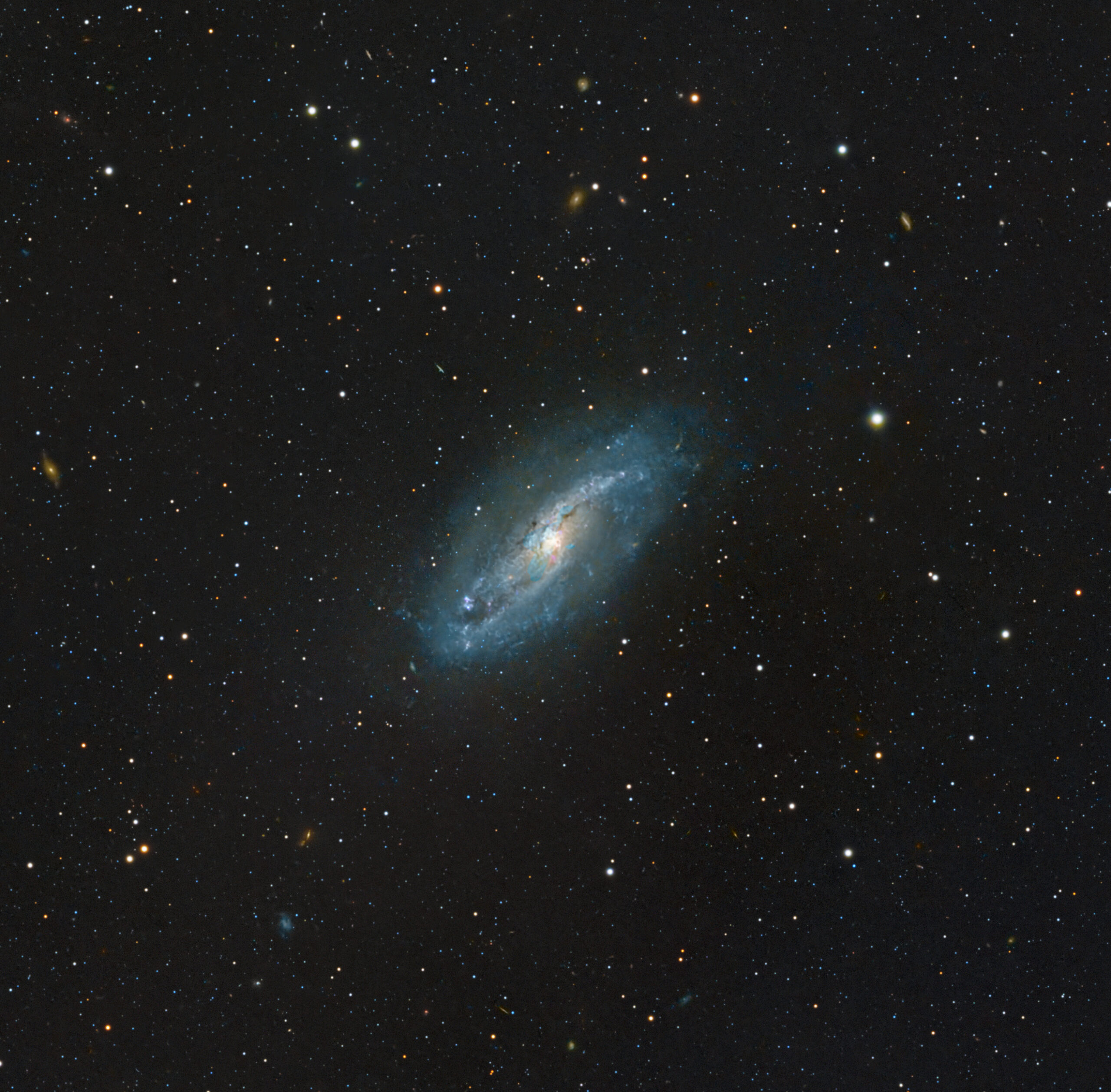
A spiral galaxy that never quite got the memo — NGC 406 is a cosmic construction zone still under development.
NGC 406 is an intermediate spiral galaxy classified as SAB(s)cd, lying about 64 million light-years away in the southern constellation Tucana. Spanning roughly 50 000 light-years across — about half the size of the Milky Way — it covers an apparent 2.6 × 1.1 arcminutes on the sky. But neat symmetry is not its strong suit.
This is a flocculent spiral, with arms that look more like scattered patches than elegant, sweeping structures. That chaotic appearance is no accident — it suggests that star formation here is driven by local instabilities rather than the grand density waves that shape more orderly spirals. Bright knots of pink and blue mark vigorous star-forming regions, some even displaced from the disk plane, hinting that NGC 406 may have been disturbed by a past gravitational encounter or minor merger.
A faint, uneven stellar halo extends beyond the main body, more prominent on one side than the other, further supporting the idea of past interaction. Subtle dust lanes and filamentary structures weave through the central regions, tracing the raw material for future stars and adding to the galaxy’s mottled, unsettled look.
NGC 406 is far from a polished spiral — it’s a small galaxy still very much under construction, reshaped by its history and bursting with stellar birth.
Imaged in LRGB on my Planewave CDK 1000 at Observatorio El Sauce, Chile.
Image acquisition and processing: Mike Selby