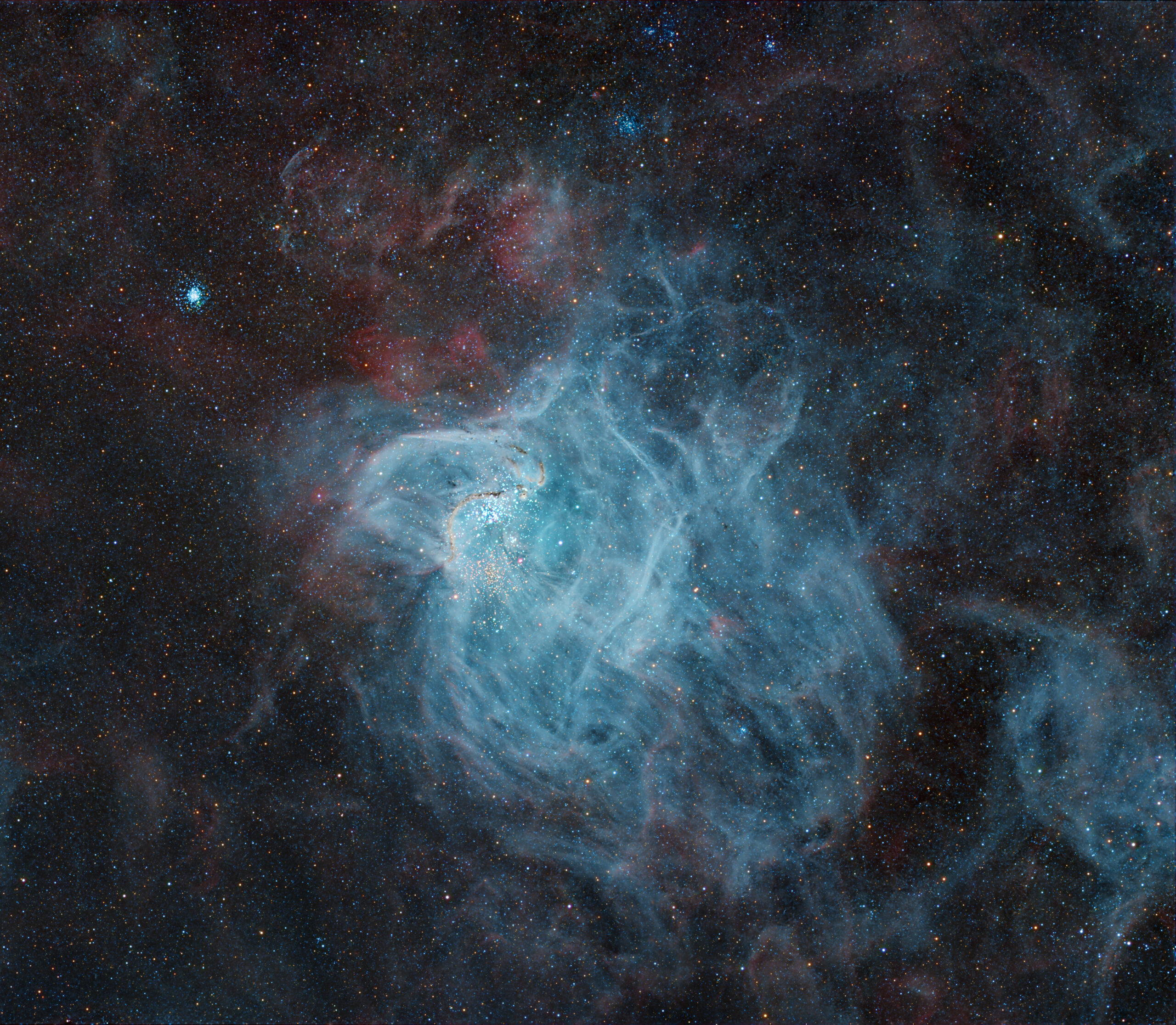
NGC 346 — Sculpted by Stellar Winds
A turbulent cradle of stars in the Small Magellanic Cloud.
Roughly 200 000 light-years away in the Small Magellanic Cloud — a dwarf satellite galaxy of the Milky Way — NGC 346 blazes as the most active star-forming region in that nearby system. Lying within Tucana, it spans nearly 200 light-years, its tangled appearance shaped by the fierce radiation and winds of massive, newborn stars.
At its heart lies the NGC 346 OB Association, a cluster packed with hot O- and B-type stars whose ultraviolet radiation carves deep cavities and filigrees of glowing gas. The dominant teal-blue tone arises from strong O III emission, a sign of extreme ionization where energetic photons strip oxygen atoms of multiple electrons — a rare color balance that reveals the region’s intense radiation field.
This deep view brings out delicate filaments and diffuse envelopes extending well beyond the bright core, tracing older supernova-driven flows interleaved with the current wave of star formation.
Just above the nebula sits a compact globular cluster, BS 90, its ancient stars roughly 4–5 billion years old — a striking contrast to the few-million-year-old cluster inside NGC 346. It’s a meeting of cosmic generations: an ancient survivor poised beside a storm of stellar creation.
Because the SMC is a close satellite of our Galaxy, we can resolve this nebula in exceptional detail; in most other galaxies (apart from the equally nearby LMC), such fine structure is simply too distant to see. NGC 346 is therefore a rare extra-galactic laboratory where the processes of stellar birth can be studied almost with Milky Way–like clarity.
Imaged in LRGB Ha and OIII on my Planewave CDK 700 at Observatorio El Sauce, Chile.
Image acquisition and processing: Mike Selby