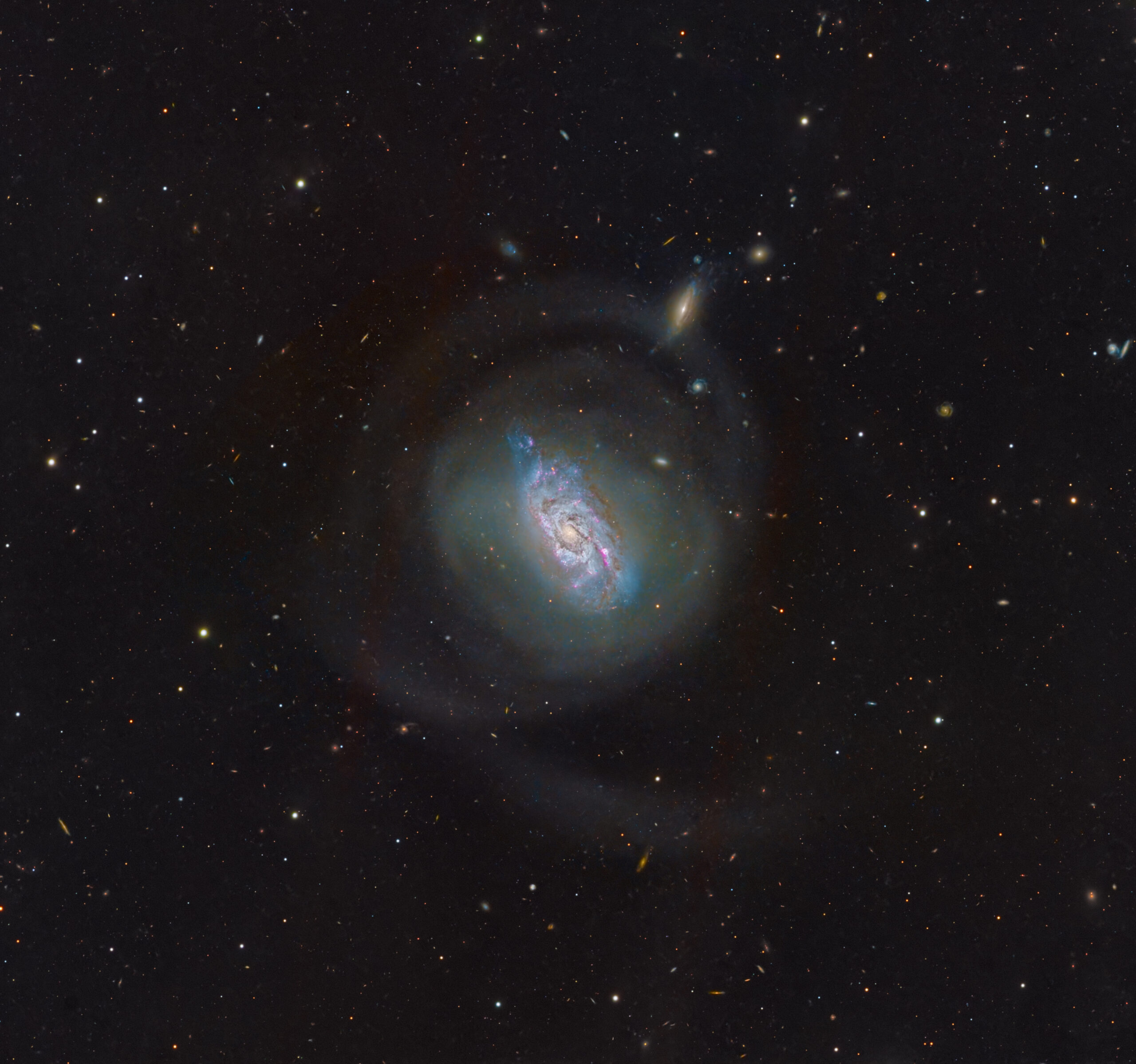
NGC 1084 — Echoes in the Halo
A spiral shaped by time, its history written in the halo.
In the constellation Eridanus, about 63 million light-years away, lies NGC 1084, a SA(s)c spiral galaxy whose bright, structured core contrasts sharply with the faint, extended halo that surrounds it. Within the main disk, pale blue spiral arms wind through lanes of dust and pink H II regions, tracing the rhythm of ongoing star formation around a warm, golden nucleus.
What sets this view apart is the revelation of extremely faint arcs and diffuse shell-like structures extending well beyond the visible spiral — features that appear to have not been noted in survey data or earlier imagery. These halos vanish completely in a single five-minute exposure, existing at the very edge of detectability with an estimated surface brightness around 27.5–28 mag/arcsec². Most survey images do not reach that depth, and even the Hubble image, focused tightly on the inner disk, appears to have missed these outer regions entirely.
The color contrast between the galaxy’s regions tells a layered story: the inner spiral glows cool and blue with young stars and emission regions, while the faint outer halo takes on a subtle amber hue — light from older, metal-poor populations now spread thin across space. That gradient, from the bright heart to the diffuse edge, reflects the slow blending of youth and age within a galaxy still shaped by its own history.
These delicate outer formations are the remains of ancient minor mergers, when smaller galaxies were drawn in and torn apart by NGC 1084’s gravity. Their stars now orbit as faint filaments and diffuse shells — the fossil record of long-vanished systems. Over the next few hundred million years, these arcs will fade and phase-mix into a smooth halo, leaving only a chemical memory of what they once were.
Spanning nearly 75 000 light-years and appearing about 3.1 × 2.4 arcminutes across the sky, NGC 1084 reveals both its active present and its hidden ancestry — a spiral whose outer light still carries the imprint of long-forgotten collisions.
Imaged in LRGB on my Planewave CDK 1000 at Observatorio El Sauce, Chile.
Image acquisition and processing: Mike Selby