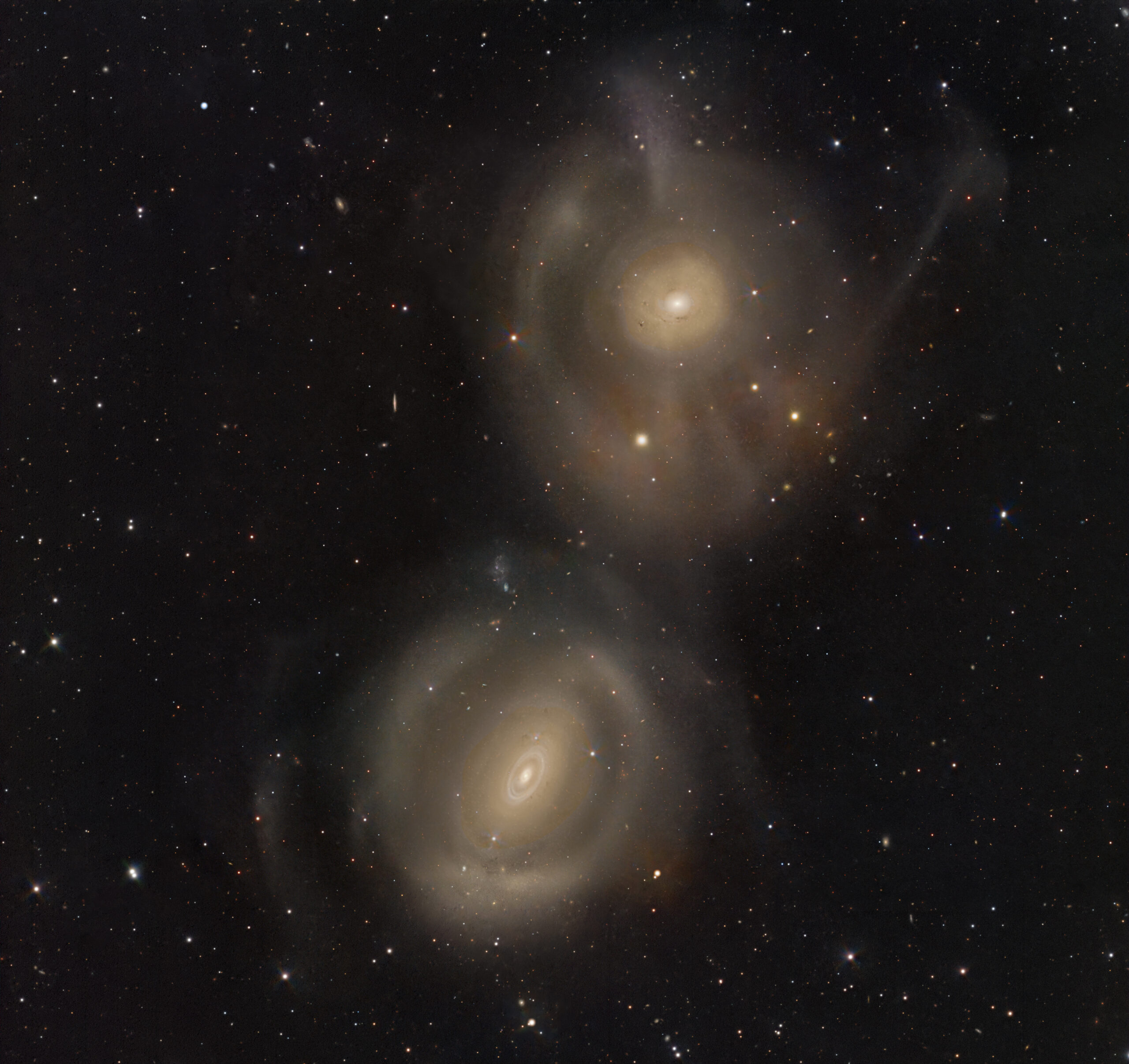
NGC 1549 & NGC 1553 — A Cosmic Shell Game
Two aging galaxies whose outer shells reveal the fingerprints of long-vanished companions.
In the constellation Dorado, about 50–55 million light-years away, the galaxies NGC 1549 (top) and NGC 1553(bottom) drift within the same group, bound by gravity and history. Though they appear tranquil, faint arcs, loops, and filaments ripple through their halos — the delicate afterimages of ancient mergers.
NGC 1549, at the top, is an elliptical galaxy (E0–E1) spanning roughly 4.9 × 4.1 arcminutes. Its smooth light hides intricate structure: faint, shell-like ripples curling outward — the aftermath of smaller galaxies long since absorbed. These shells arise through phase-wrapping, as tidal debris from an accreted companion oscillates through the host, its stars bunching together at orbital turning points to form ephemeral arcs of light.
Below it, NGC 1553 is a lenticular galaxy (SA(r)0) measuring about 4.5 × 2.8 arcminutes. Its soft central ring and flattened disk betray a spiral ancestry now subdued beneath an aging halo. Like its partner, it bears concentric shells and diffuse plumes, and their extended envelopes overlap faintly — a quiet sign that gravitational tides still link the pair across intergalactic space.
Each system spans more than 120 000 light-years, together forming one of the southern sky’s most striking examples of post-merger evolution — galaxies that appear at rest yet carry the visible scars of their consuming past. Over cosmic time, their shells will dissolve back into smooth halos, erasing the last traces of the galaxies they once devoured.
Imaged in LRGB on my Planewave CDK 1000 at Observatorio El Sauce, Chile.
Image acquisition and processing: Mike Selby