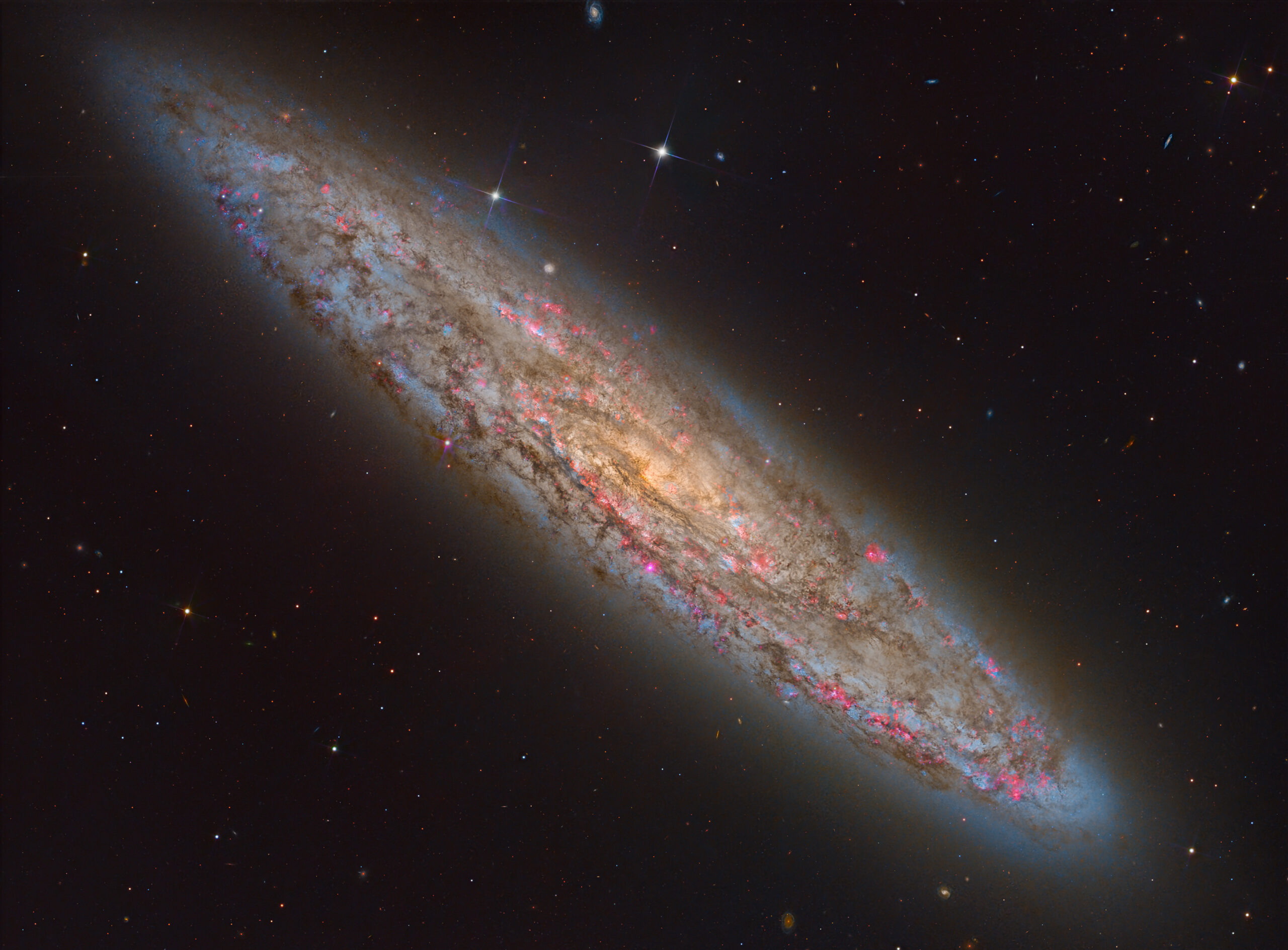
NGC 253 — The Sculptor Galaxy, a dusty spiral ablaze with starbirth
A furnace of creation in the southern sky.
Set in the constellation Sculptor, NGC 253 is a barred spiral galaxy (SAB(s)c) about 11.4 million light-years away. One of the brightest spirals in the southern sky, its nearness reveals extraordinary structure — from tangled dust lanes and glowing H II regions to a faint, misty halo that drifts beyond the disk.
At its center lies a compact nuclear starburst ring, encircling a quietly accreting supermassive black hole roughly five million times the mass of the Sun. The region seethes with dense molecular gas, young clusters, and supernova remnants, driving a powerful galactic superwind that blows material high above the plane. This outflow, visible in deep optical and X-ray light, shows a galaxy both forming and expelling its stars — a turbulent core glowing with creation.
Beyond the dust and light, NGC 253 hides layers of invisible complexity. Magnetic filaments thread through its disk and halo, guiding charged particles and shaping the outflow into slender arcs. X-ray chimneys vent hot plasma from clustered supernovae, piercing the halo with streams of high-energy gas. And buried in the starburst nucleus lies one of the most chemically rich regions known beyond the Milky Way, filled with hundreds of molecular species — from water and methanol to complex organics that trace the building blocks of life.
Outside this chaos, the outer arms fall quiet and faintly blue, their dust-softened light marking the calm after creation. The contrast between the blazing nucleus and tranquil periphery captures NGC 253 in mid-transformation — a spiral balancing the intensity of its youth against the serenity that follows.
Spanning nearly 70 000 light-years and appearing about 27 × 7 arcminutes across the sky, NGC 253 remains one of the south’s most intricate and revealing spirals — a galaxy of dust, fire, and light, still forging its story among the stars.
Imaged in LRGB and H alpha on my Planewave CDK 1000 at Observatorio El Sauce, Chile.
Image acquisition and processing: Mike Selby