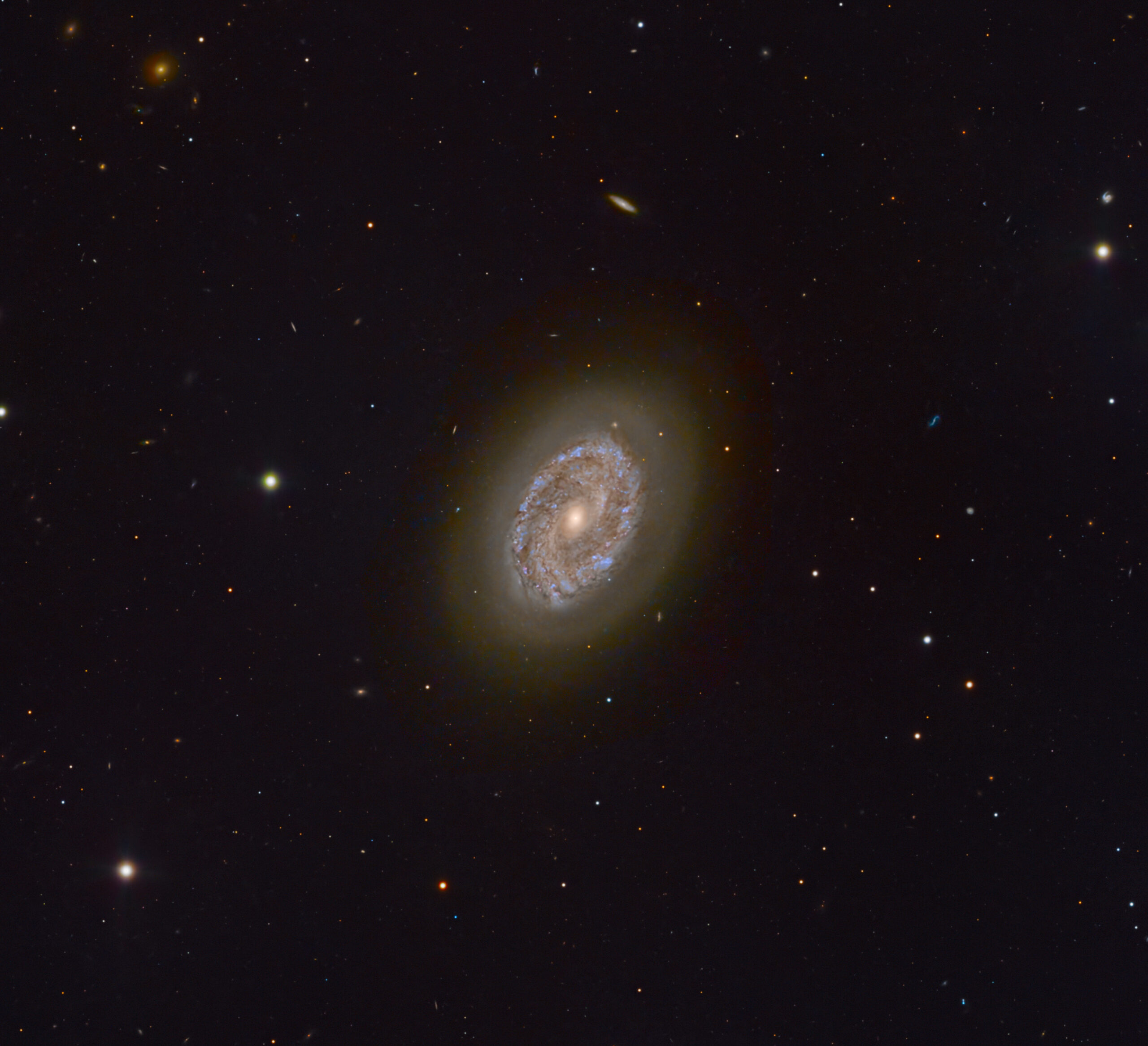
NGC 1436 — A ring forged by a fading spiral
Where a spiral’s arms fade, a ring of stars endures.
Set in the constellation Eridanus, on the outskirts of the Fornax Cluster, NGC 1436 (also cataloged as NGC 1437) is a barred spiral galaxy with an inner ring, classified SAB(rs)bc, about 62 million light-years away. At first glance it doesn’t resemble a classic spiral — its arms are short, tightly wound, and merge quickly into a smooth ring that dominates the galaxy’s appearance. Beyond that, the outer disk fades into a faint amber halo with little trace of extended spiral structure.
This morphology arises from bar-driven resonance, where gas and stars accumulate at orbital frequencies matching the bar’s rotation. Over time, that process forms a nearly closed inner ring, rich in gas and glowing with Hα emission from ongoing star formation. The bar acts as a gravitational conduit, slowly feeding material inward to sustain the ring while the outer disk grows quiet. The result is a galaxy caught mid-evolution — a once-youthful spiral turning toward a more quiescent, lenticular form, its center still bright while its outer arms dissolve into haze.
The surrounding halo glows with the warm light of older stars, slightly brighter toward the upper right, while a faint spur near one o’clock hints at tidal nudges from the Fornax environment. A thin edge-on background galaxy hovers above the halo, adding depth to the field alongside a scatter of distant systems.
Spanning about 56 000 light-years and appearing roughly 3.1 × 2.4 arcminutes across the sky, NGC 1436 captures a moment of graceful transformation — a galaxy whose last burst of youth still burns in a ring of stars.
Imaged in LRGB on my Planewave CDK 1000 at Observatorio El Sauce, Chile.
Image acquisition and processing: Mike Selby