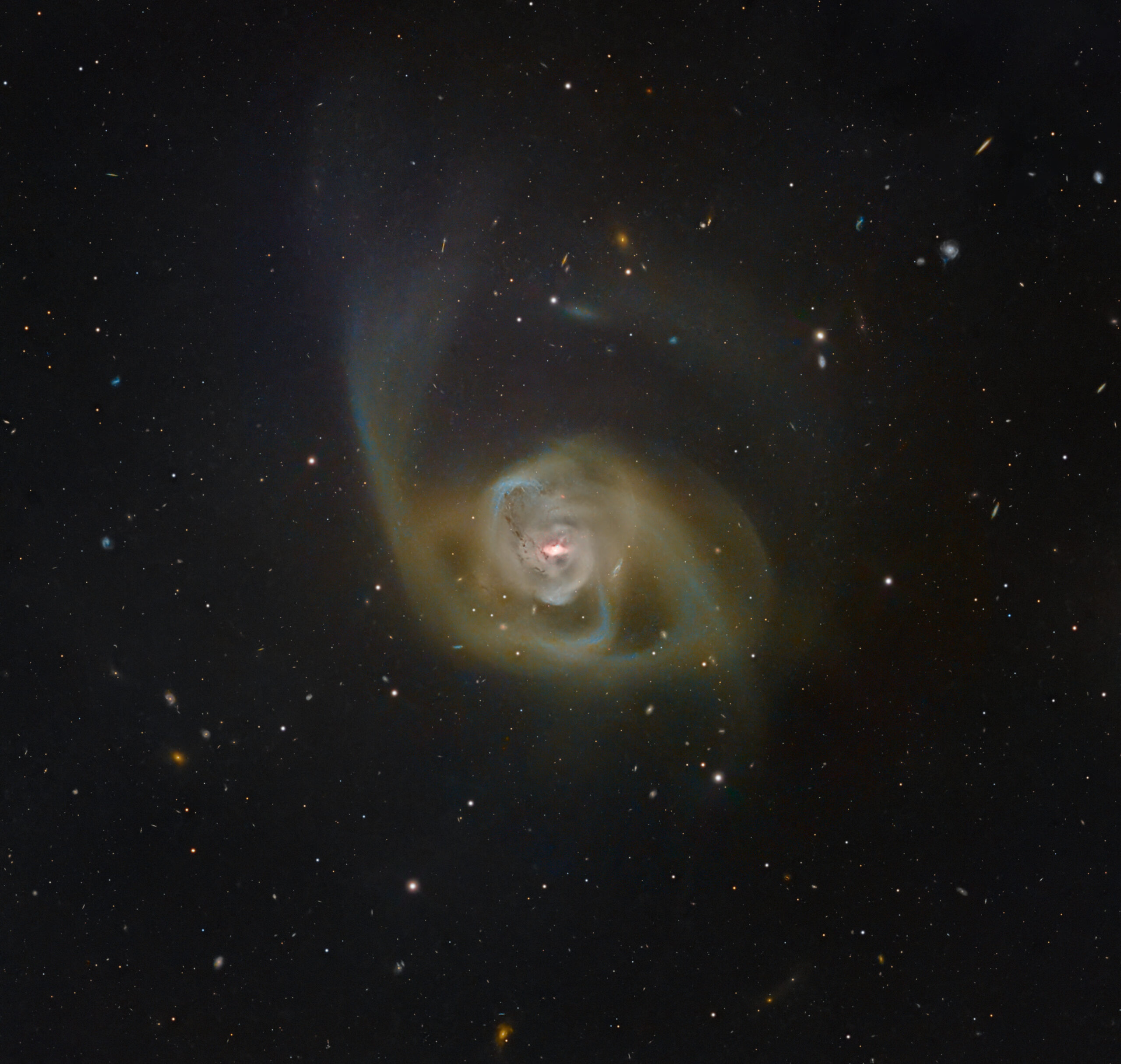
NGC 7727 — A cosmic afterimage of two galaxies colliding
Shrouded in wisps of starlight, NGC 7727 is the fading aftermath of a galactic collision that began nearly a billion years ago. Classified as SAB(s)a pec, this peculiar system lies about 89 million light-years away in the constellation Aquarius, standing as one of the most remarkable nearby merger remnants ever observed. Its distorted form, looping tidal streams, and ghostly outer filaments trace the turbulent dynamics of two galaxies that have mostly merged but not yet found peace.
At the heart of NGC 7727 lurk two supermassive black holes only about 1,600 light-years apart—the closest such pair ever discovered. The larger weighs roughly 154 million M☉, while the smaller is about 6 million M☉. They are destined to merge within a few hundred million years, an event that will one day ripple through the cosmos as powerful gravitational waves. Surrounding the core, faint Hα emission glows from regions of residual star formation and ionized gas, marking the lingering energy of the merger. Around it, arcs and shells of stars reveal the slow settling of tidal debris, while subtle bluish knots trace the last pockets of young stellar activity.
The galaxy spans about 150,000 light-years, appearing roughly 4.7 × 3.5 arcminutes across the sky. Its warped disk and disrupted dust lanes blur the line between spiral and elliptical, offering a glimpse of the kind of hybrid form the Milky Way and Andromeda may one day become. NGC 7727’s beauty lies in its disarray — a cosmic relic still in transition, quietly fading into equilibrium after an era of violence and transformation.
Imaged in LRGB Ha on my Planewave CDK 1000 at Observatorio El Sauce, Chile.
Image acquisition and processing: Mike Selby