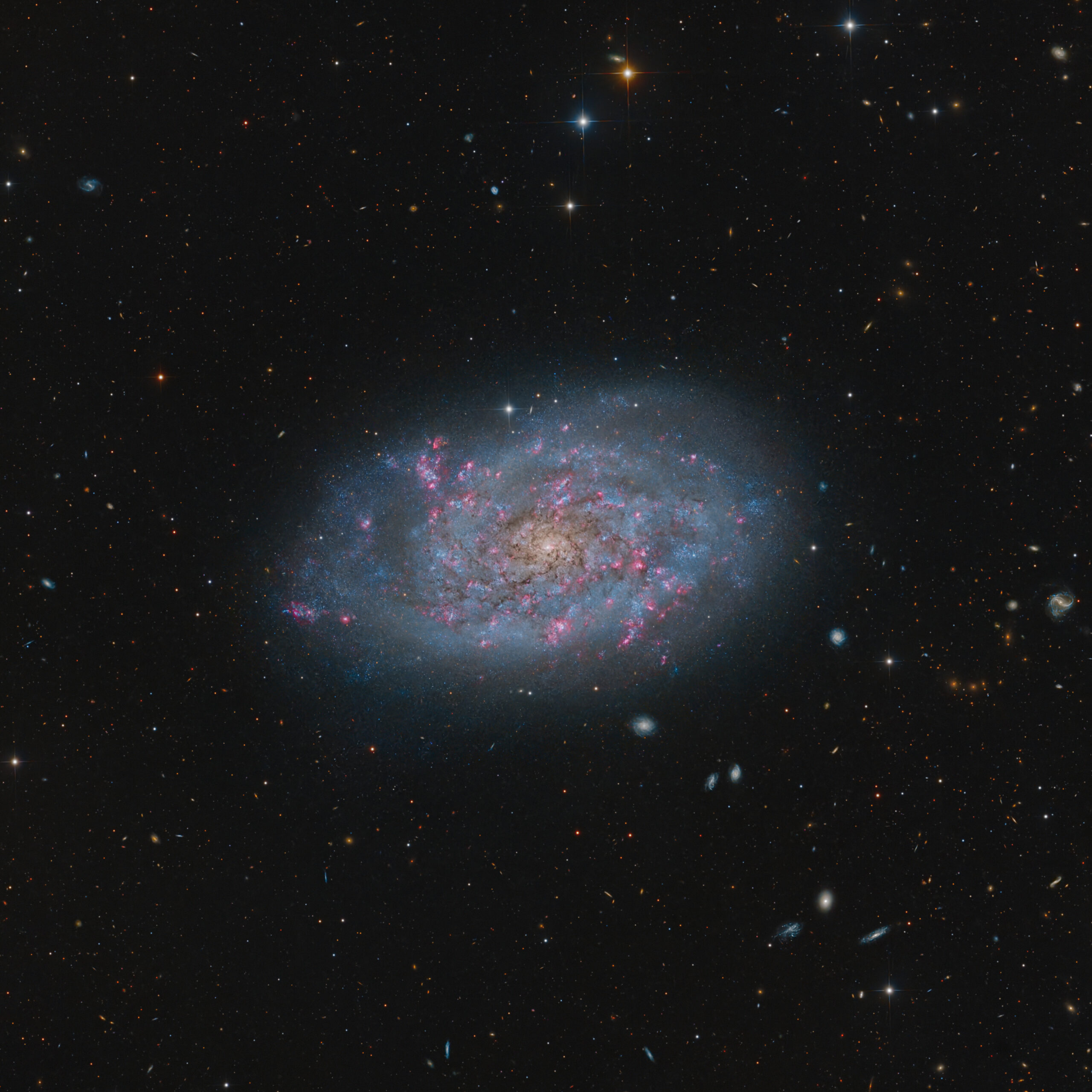
NGC 7793 — a stellar cauldron on our galactic doorstep
Only about 12.7 million light-years away in the constellation Sculptor, NGC 7793 is one of the brightest members of the Sculptor Group — a loose collection of nearby galaxies just beyond the Local Group. Classified as SA(s)d, it’s an unbarred late-type spiral with loosely wound arms and no pronounced central bulge. Spanning roughly 55,000 light-years across, it covers about 9.3 × 6.3 arcminutes on the sky.
Though smaller than the Milky Way, NGC 7793 is a hotbed of stellar activity. Its patchy, flocculent arms are scattered with brilliant pink H II regions — vast hydrogen clouds ionized by newborn star clusters — and bursts of intense star formation that shine against the background of older stars. The fragmented structure is driven more by local star-forming events than by the grand density waves seen in more symmetrical spirals.
NGC 7793 also hosts some remarkable high-energy phenomena, including ultraluminous X-ray sources, powerful stellar winds, and supernova remnants. Among its most intriguing features is one of the nearest known microquasars beyond the Milky Way, offering astronomers rare insights into the physics of stellar-mass black holes and their jets.
A chaotic, compact cousin to our own galaxy, NGC 7793 is a vivid example of how creation and destruction intertwine in the life of a spiral galaxy — all unfolding just beyond our cosmic neighborhood.
Imaged in LRGB Ha on my Planewave CDK 1000 and RiDK 700 at Observatorio El Sauce, Chile.
Image acquisition and processing: Mike Selby