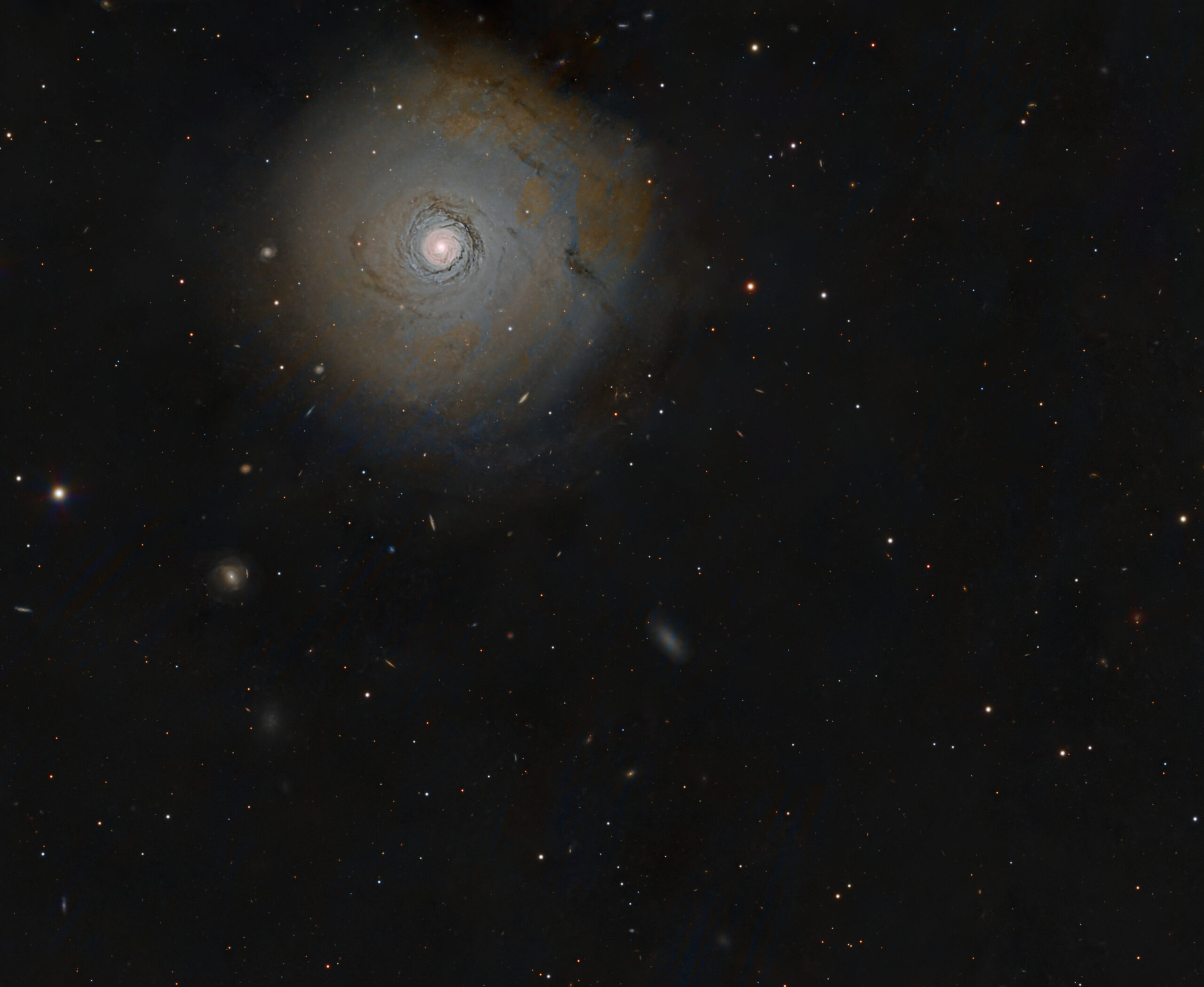
A galaxy with a turbulent past — NGC 7213
This Seyfert galaxy in the constellation Grus sits about 77 million light years away, showing off a structure that seems caught between a spiral and a lenticular form. Classified in NED as SA(s)0⁰, it’s an unbarred lenticular with a Sy 1.5/LINER nucleus.
NGC 7213’s tightly wound core is surrounded by faint shells and ripples—evidence of past mergers. Subtle dust lanes spiral inward, and the halo has an onion-like layering, debris from galaxies long since devoured. At its heart lies an active galactic nucleus powered by a supermassive black hole accreting at a very low rate. My Hα data highlights this restless center. The galaxy is a bit of a laboratory for astrophysicists: it shows a strong, narrow Fe Kα line but no reflection hump in X-rays, and its double-peaked Hα profile lets us see light directly from the accretion disc. Both point to a truncated disc and a hot inner flow, with jet and coronal activity tied to its radio output.
The galaxy spans about 69,000 × 63,000 light years, with an apparent size of 3.1′ × 2.8′. Scattered across the field are numerous background galaxies, a reminder of the busy cosmic environment. NGC 7213 blends the elegance of a spiral-like core, the ghostliness of a lenticular envelope, and the intrigue of an active galactic nucleus on display as a real-time black hole laboratory.
This was a very difficult object to process, I had to frame it offset due to a very bright star that was washing across the frame. With the field derotation of the CDK 1000, multiple spikes are created from bright stars that can “shower” the target.
Imaged in LRGB Ha on my Planewave CDK 1000 at Observatorio El Sauce, Chile.
Image acquisition and processing: Mike Selby