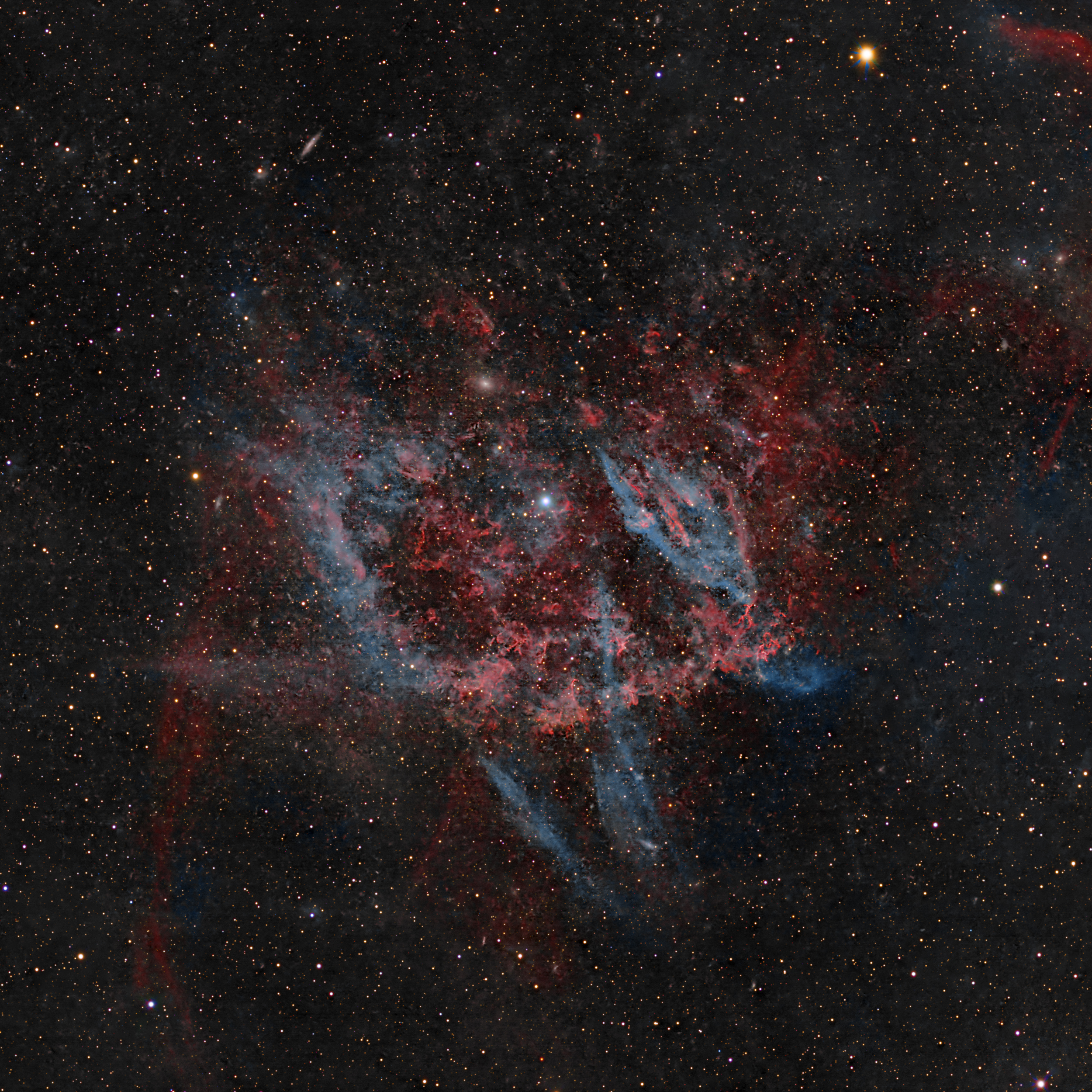
Filaments of Fury: Wolf-Rayet 71 and Its Cosmic Bubble
High in the southern skies of Triangulum Australe, about 15,000 light-years away, blazes a spectacular stellar powerhouse—Wolf-Rayet 71 (WR 71). This rare Wolf-Rayet star, a massive, evolved star nearing the end of its life, unleashes intense stellar winds that blast outward at millions of kilometers per hour.
These fierce winds collide with surrounding interstellar gas and dust, sculpting a delicate emission nebula glowing faintly in ionized hydrogen (deep reds) and oxygen (ethereal blues). In my image, you can see this cosmic bubble, where filaments and arcs trace shock fronts and turbulent flows shaped by the star’s powerful energy. Despite WR 71’s ferocity, the nebula’s Hα and OIII signals are quite faint and require considerable integration time to reveal their subtle structures and colors.
WR 71, nestled within Triangulum Australe, exemplifies how massive stars help enrich their galaxies with heavy elements, seeding the raw materials for future stars, planets, and potentially life itself. Captured using narrowband filters that isolate hydrogen-alpha (Hα) and doubly ionized oxygen (OIII), this photograph reveals the intricate, hidden beauty of a nebula set against a rich backdrop of stars.
The life and death of massive stars like WR 71 are cosmic engines of transformation—a stellar performance written in glowing gas and starlight.
Imaged in HOO RGB on my Planewave CDK 700 at Observatorio El Sauce, Chile.
Image acquisition and processing: Mike Selby
www.throughlightandtime.com
www.instagram.com/throughlightandtime/
www.facebook.com/masterdarksastro/