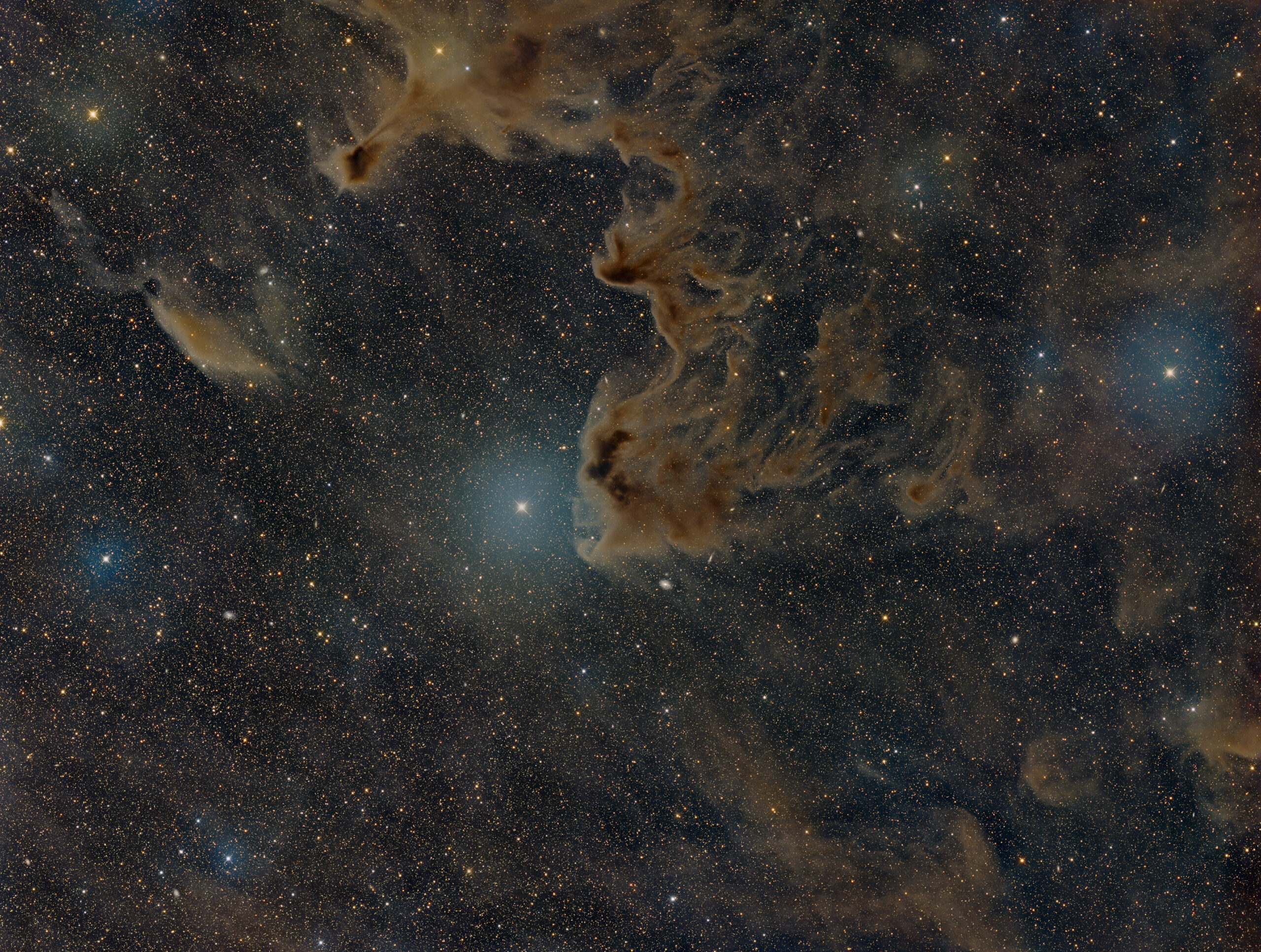
Where Shadows Hide the Seeds of Stars: LDN 122 in Ophiuchus
Floating like smoky wisps against a star-studded sky, the dark nebula LDN 122 weaves intricate shapes through the constellation Ophiuchus.
These cosmic shadows are interstellar dust clouds, dense enough to obscure the light of background stars. Though they appear dark and mysterious, they’re the raw material from which new stars and planets eventually emerge. The delicate brownish hues in the image reveal the presence of Galactic cirrus—tenuous dust illuminated by the faint glow of the Milky Way.
LDN 122 is part of the catalog of dark nebulae compiled by astronomer Beverly Lynds and lies roughly 460 light-years away, as part of the broader Ophiuchus dark cloud complex. It spans about 15 × 10 arcminutes on the sky. In my image, taken at bin 2 with a pixel scale of 1.4 arcseconds/pixel, my field of view is approximately 1.86° × 1.24°, allowing LDN 122 to fit comfortably within the frame and occupy around 13% of the width and height.
Long exposure imaging is essential to reveal these faint clouds and the subtle textures hidden in the cosmic dark. It’s a powerful reminder that some of the most intriguing vistas in the universe are not blazing nebulae or clusters of bright stars, but these quiet, shadowy places where new stars sleep in the darkness.
Imaged in LRGB on my Planewave DR 350 at Observatorio El Sauce, Chile.
Image acquisition and processing: Mike Selby