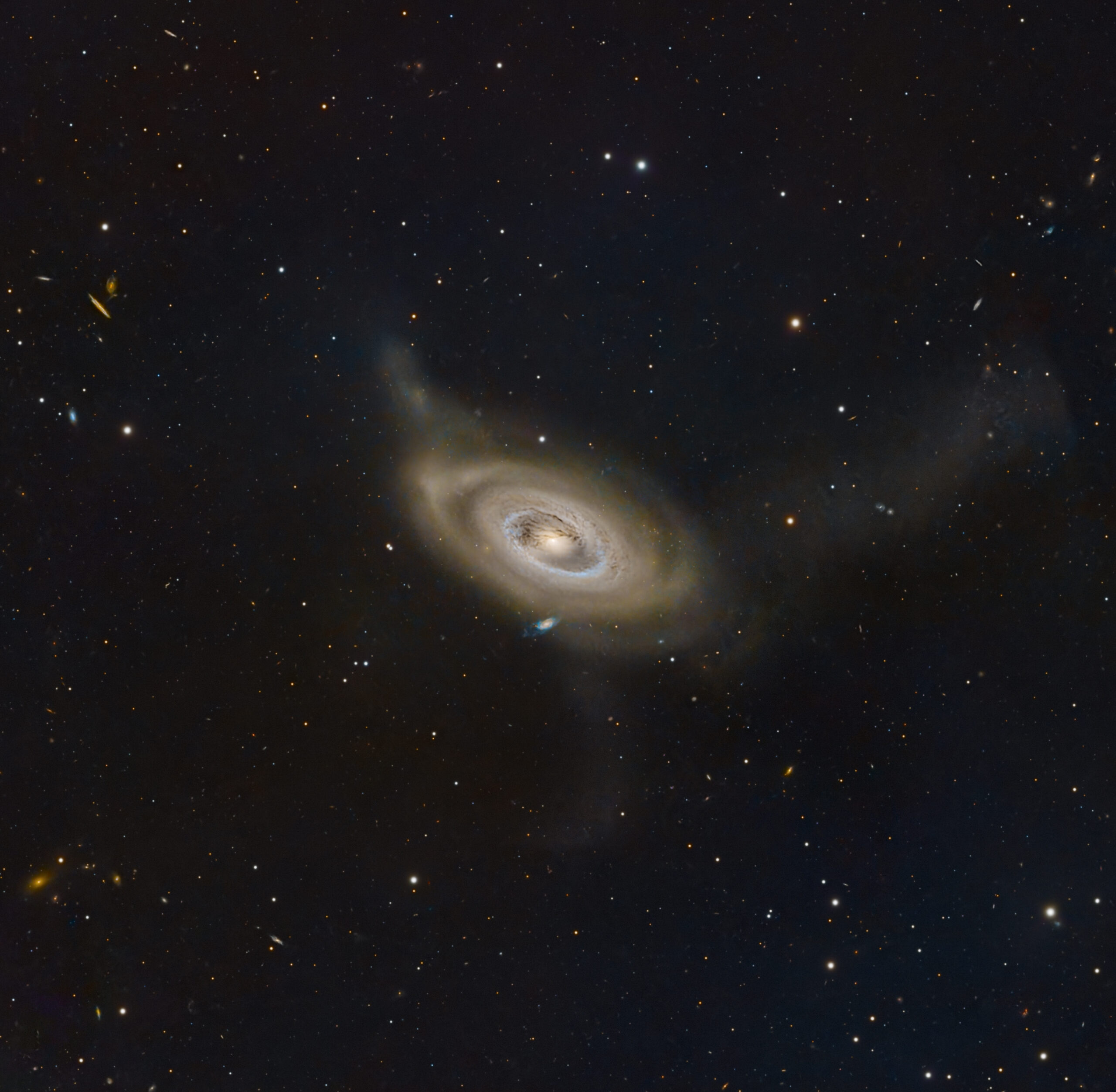
NGC 5750 — Spirals, Bars, and Mysterious Outflows
NGC 5750 is a barred spiral galaxy of morphological type (R)SB(r)0/a, located about 205 million light-years (63 Mpc)away in the constellation Virgo. It stretches roughly 70,000 light-years across, with an apparent size of about 1.8 × 1.3 arcminutes on the sky.
Beyond its prominent bar and tightly wound spiral arms, NGC 5750 reveals unusual outflows and faint tidal streamsextending far beyond its disk—evidence of past gravitational interactions or minor mergers. Its spiral arms are asymmetric and somewhat distorted, hinting at dynamical disturbances in its history. The galaxy also shows a faint outer pseudoring and a bright inner ring encircling the bar.
This image clearly captures dust lanes near the galaxy’s nucleus, adding delicate texture and contrast to the central region. These dark filaments trace cooler gas and dust spiraling inward under the influence of the bar, potentially fueling star formation or activity around the core.
Above NGC 5750 lies LEDA 213598 (2MASX J14453808+0147575), a small background galaxy located about 850 million light-years away. In this image, LEDA 213598 appears superimposed over faint tidal streams and can give the illusion of merging into NGC 5750 or being part of its outflows. However, it’s not physically interacting with NGC 5750 and lies far beyond it—an excellent example of how deep-sky images often reveal coincidental alignments of unrelated cosmic structures.
NGC 5750 stands as a vivid example that galaxies are not static pinwheels but living systems, continuously shaped and transformed by cosmic forces over billions of years.
Imaged in LRGB on my Planewave CDK 1000 at Observatorio El Sauce, Chile.
Image acquisition and processing: Mike Selby